For years, I did what millions of women do every day—I took a tiny pill at the same time each morning, trusting it to protect me from an unplanned pregnancy. It was routine. It was reliable. And for a long time, it worked. But somewhere along the way, I started to feel like something was off. My body didn’t feel like my own anymore. The mood swings, the weight fluctuations, the nagging sense that I was managing side effects rather than living freely—it all added up. I began to wonder: Is this really my only option?
That question led me down a path I never expected. It led me to rethink what birth control could be, and ultimately, to make a switch that changed everything. I quit the pill and turned to Natural Cycles—the first FDA-cleared digital birth control—a decision rooted not in rebellion, but in reclaiming control over my body, my health, and my choices.
The Pill: A Double-Edged Convenience
The birth control pill has been a cornerstone of reproductive freedom for decades. It’s effective, accessible, and culturally normalized. For many women, it’s the default choice—the first thing doctors recommend and the easiest option to obtain. I started taking it in my early twenties, and at first, it felt empowering. I could plan my life without the fear of an unexpected pregnancy. But as the months turned into years, the trade-offs became harder to ignore.
Hormonal birth control works by flooding your system with synthetic hormones that prevent ovulation. It’s simple in theory, but the reality is more complex. Those hormones don’t just stop an egg from being released—they affect your entire endocrine system. For me, that meant unpredictable mood swings, a diminished libido, and a persistent brain fog that I couldn’t shake. I felt like I was living life through a filter, slightly detached from my own emotions and energy.
And I wasn’t alone. Studies show that hormonal contraceptives are associated with increased rates of depression, anxiety, and other mood disorders. Some women experience weight gain, migraines, or changes in their menstrual cycle. Others, like me, simply feel different—not quite themselves. The pill does its job, but at what cost?
The Breaking Point
My turning point came during a routine checkup. My doctor mentioned, almost casually, that I might want to consider taking a break from the pill at some point to “reset” my system. The word reset stuck with me. Why did my body need resetting? What had I been doing to it all these years?
I started researching alternatives. I wasn’t ready for an IUD—the idea of a device inside my body felt invasive, and I’d heard too many stories of painful insertions and unpredictable side effects. Condoms alone didn’t feel secure enough for someone in a committed relationship. Fertility awareness methods intrigued me, but they seemed complicated and unreliable without the right tools.
That’s when a friend mentioned Natural Cycles. At first, I was skeptical. Another fertility app? But then she explained: Natural Cycles isn’t just an app—it’s the first birth control app to receive FDA clearance in the United States and CE marking in Europe as a medical device. It was founded by particle physicist Dr. Elina Berglund, who worked on the team that discovered the Higgs Boson particle at CERN. She created Natural Cycles after becoming frustrated with the side effects of hormonal contraception herself.
For the first time, I saw a path forward that didn’t involve pumping my body with hormones or inserting foreign objects. This was science-backed, clinically validated, and completely natural.
What Is Natural Cycles?
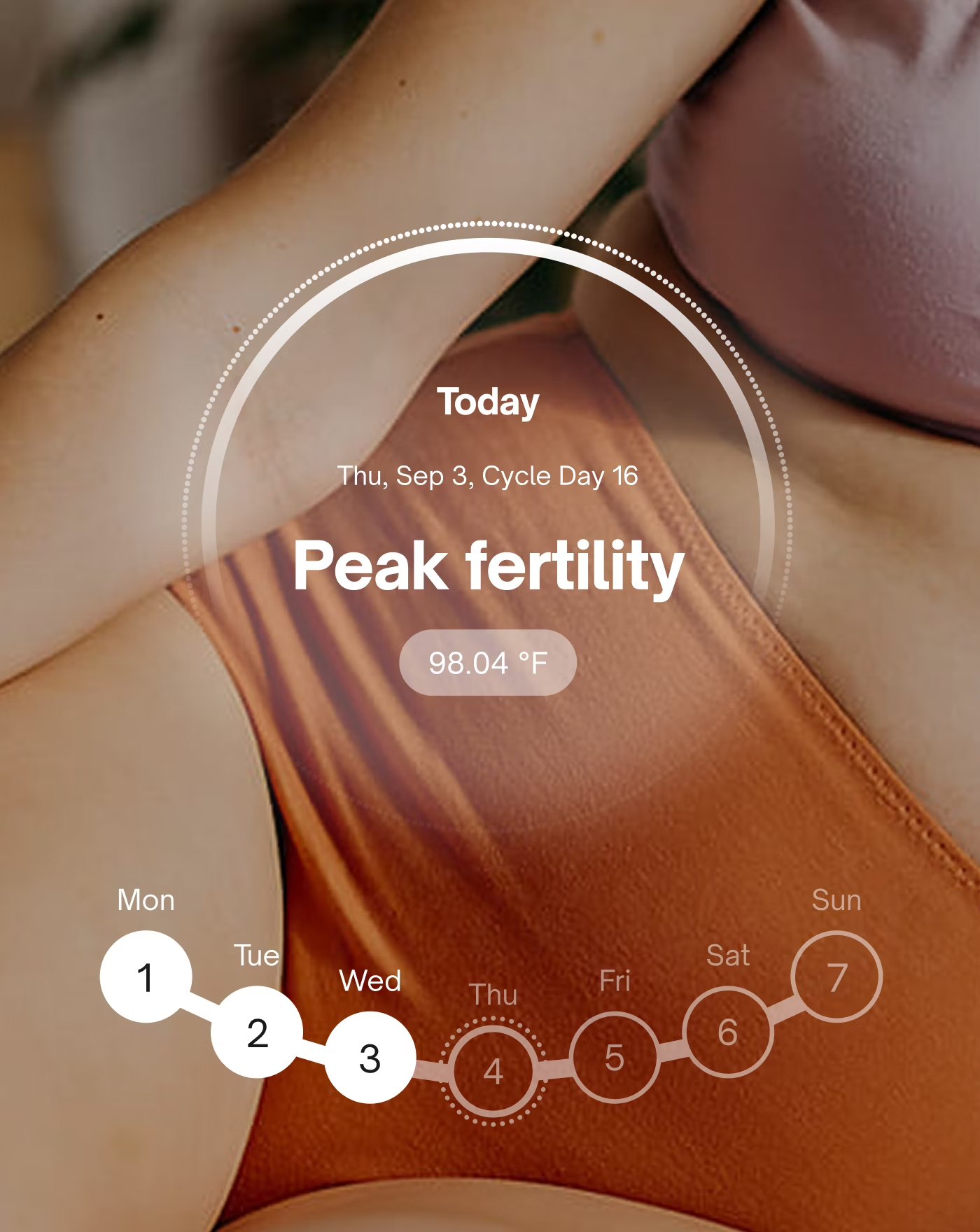
Natural Cycles is a digital birth control app that uses a sophisticated algorithm to determine your daily fertility status based on your basal body temperature. It’s not guesswork or the outdated rhythm method—it’s precision technology applied to the science of fertility.
Here’s how it works: Every morning, before getting out of bed, I take my temperature using the Natural Cycles thermometer (though any basal thermometer works). I enter it into the app, which takes just seconds. The algorithm—trained on hundreds of thousands of menstrual cycles—analyzes my data to pinpoint exactly where I am in my cycle.
The app then gives me a simple color-coded result:
- Green days mean I’m not fertile and can have unprotected sex
- Red days mean I’m fertile and need to use protection or abstain
Natural Cycles is certified as 93% effective with typical use and 98% effective with perfect use—comparable to the pill, but without any hormones or side effects.
The Science Behind Natural Cycles
What sets Natural Cycles apart from traditional fertility awareness methods is the algorithm. Dr. Berglund’s background in physics and data science allowed her to create a system that accounts for the natural variations in every woman’s cycle. The algorithm learns from your unique patterns, becoming more accurate over time.
The science is simple: body temperature rises slightly after ovulation due to the hormone progesterone. By tracking this shift daily, Natural Cycles can identify your fertile window with remarkable precision. The app also factors in sperm survival time (up to 5 days) and variations in cycle length to provide a conservative, safe prediction.
The FDA clearance wasn’t handed out lightly. Natural Cycles conducted extensive clinical studies involving thousands of women. The results demonstrated that when used as directed, it’s as effective as traditional contraceptive methods—without the hormones.
My First Months with Natural Cycles
The first few weeks off hormonal birth control were an adjustment. My body was recalibrating, and I could feel it. Natural Cycles walks you through this transition period, noting that it may take a few cycles for your body to regulate after stopping hormones. During this time, I had more red days while the algorithm learned my unique patterns.
But even during the learning phase, the changes were profound. My cycle returned, more predictable than I remembered. My mood stabilized. The fog lifted. I felt sharper, lighter, more present. It was like meeting myself again after years of distance.
Taking my temperature each morning became a ritual—a two-second pause before starting my day. The Natural Cycles app is beautifully designed, intuitive and encouraging. Each morning, I’d open it to see my status. Green days brought relief and freedom. Red days required planning, but they were never a surprise. The app predicts them in advance, so my partner and I could prepare.
What surprised me most was how empowering it felt to understand my body’s rhythm. Natural Cycles doesn’t just prevent pregnancy—it educates you about your cycle. I learned when I was most energetic, when I needed more rest, and how my hormones affected my mood and energy. This knowledge extended beyond birth control; it became a tool for overall wellness.
Life After the Pill: The Natural Cycles Difference
Six months in, I can’t imagine going back. My experience with Natural Cycles has been transformative, not just as birth control but as a daily practice of body awareness and self-care.
The Physical Changes: Without synthetic hormones, my body returned to its natural state. My libido came back—something I hadn’t realized I’d lost until it returned. The bloating disappeared. My skin cleared up. Even my energy levels became more consistent throughout the month.
The Mental Clarity: The brain fog I’d attributed to stress or age vanished. I felt more emotionally balanced, more connected to my feelings rather than watching them from a distance.
The Relationship Benefits: Using Natural Cycles became a shared responsibility. My partner downloaded the app too, so we’re both aware of my fertility status. It opened up conversations about our bodies, family planning, and mutual responsibility that we’d never had before. It brought us closer.
The Empowerment: Perhaps most importantly, Natural Cycles gave me ownership of my reproductive health. I’m not dependent on a prescription, a doctor’s appointment, or a pharmacy. I’m equipped with knowledge and tools to make informed decisions every single day.
Real Women, Real Results
I’m not alone in my experience. Natural Cycles has over 2.5 million registered users worldwide, with hundreds of thousands of women trusting it as their primary form of birth control. The app’s community features stories from women who’ve experienced similar transformations—freedom from hormones, deeper body awareness, and renewed confidence in their reproductive choices.
Clinical studies back this up. Research published in major medical journals has validated Natural Cycles’ effectiveness. A 2017 study in Contraception followed over 22,000 women and confirmed the app’s real-world effectiveness rate. Another study in 2019 showed high user satisfaction, with most women continuing to use Natural Cycles long-term.
Beyond Birth Control: Planning for the Future
One of the aspects I love most about Natural Cycles is its versatility. The same technology that prevents pregnancy can help you achieve it when you’re ready. With a simple mode switch in the app, Natural Cycles transforms into a fertility planning tool, identifying your most fertile days to optimize your chances of conception.
This flexibility matters. Unlike hormonal methods that can take months to clear from your system, or IUDs that require medical removal, Natural Cycles adapts to your life goals instantly. When my partner and I decide we’re ready to start a family, we won’t need to “prepare” our bodies or wait for hormones to regulate. We’ll simply switch modes and use the same data to pursue pregnancy.
Is Natural Cycles Right for You?
Natural Cycles works best for women who:
- Want hormone-free, non-invasive birth control
- Have regular sleep schedules (for consistent temperature readings)
- Are in stable, communicative relationships
- Value data and want to understand their bodies
- Can commit to taking their temperature most mornings
- Are comfortable with red days that require protection or abstinence
It may not be ideal if you:
- Have very irregular cycles
- Travel frequently across multiple time zones
- Prefer a “set it and forget it” method
- Need immediate maximum effectiveness (the algorithm needs time to learn your patterns)
The beauty is that it’s completely reversible and risk-free to try. Natural Cycles offers a satisfaction guarantee, and you can always discontinue if it doesn’t suit your lifestyle.
How to Get Started with Natural Cycles
Getting started is simple:
- Download the app from the App Store or Google Play
- Subscribe to a plan (monthly or annual options available)
- Receive your thermometer (included with subscription)
- Start measuring your temperature each morning
- Follow your daily fertility status and use protection on red days
Natural Cycles provides extensive support through in-app guides, educational content, and responsive customer service. You’re never alone in your journey.
A New Kind of Freedom
Quitting the pill and switching to Natural Cycles was one of the best decisions I’ve made for my health. It wasn’t about rejecting modern medicine—it was about embracing a method that felt aligned with who I am and how I want to live. Natural Cycles has given me clarity, confidence, and a deeper connection to my body.
We live in an era where women have more choices than ever before, and that’s something to celebrate. Whether you choose the pill, an IUD, Natural Cycles, or something else entirely, the most important thing is that the choice is yours. Your body, your health, your decision.
For me, that decision was clear: I wanted something effective, hormone-free, and empowering. I found it in Natural Cycles—the first and only FDA-cleared birth control app. And I haven’t looked back.
The future of birth control isn’t about choosing between effectiveness and wellness. With Natural Cycles, you don’t have to compromise. You can have both.
Ready to explore hormone-free birth control?
Download Natural Cycles today and join over 2.5 million women who’ve chosen to go natural. Get started with a special offer and take control of your reproductive health—naturally.
[Learn More About Natural Cycles] | [Download the App] | [Read Clinical Studies]
Natural Cycles is 93% effective with typical use and 98% effective with perfect use. It is cleared by the FDA and CE marked as a medical device for contraception.
Ready to reclaim your body?
Join millions of women who have switched to the first FDA-cleared, hormone-free birth control app. It’s risk-free to try.
Get Natural Cycles Today →